
The Rules Behind the Money

How Newton and Webacy Turn Risk Data Into Onchain Protection
Blockchains are exceptionally good at one thing: moving value and recording it immutably, for anyone to audit. But there's a piece that got left out of the smart contract, the rules that govern whether money should move in the first place. Those rules have historically lived offchain, on a piece of paper or in someone's head, impossible to enforce at the moment they matter. Newton closes that gap by making rules enforceable onchain. But a rule is only as good as the data behind it and that's where Webacy comes in. Here's how the two fit together, and why it matters whether you're an institution allocating capital or an individual chasing yield.
Vaults, and why they need watching
A vault is one of the simplest ways to earn onchain: you deposit assets, and yield comes back. A curator decides how the vault's assets are allocated to generate that return; allocators: the institutional or individual capital behind the deposits, set the mandate for how far a curator can go. The catch: most popular vaults today are backed by stablecoins, because investors want simple yield that beats treasuries. That makes a single stablecoin depeg capable of cascading through an entire ecosystem which is exactly the kind of event that needs to be caught in real time.
Newton: authorization layer
Think of Newton like the Visa network. Before a card payment settles, there's a real-time check for fraud and risk; only once it passes does the transaction go through. Newton does the same for onchain transactions, authorizing them before they settle and recording each check in the same immutable, auditable way the blockchain records the money itself. Its rules live in open, composable policy packs, that a curator can plug into their wallet through a simple integration. Newton's mainnet beta is live, and VaultKit makes that effortless.
Webacy: from “Norton for your wallet” to ratings for modern finance
Webacy began as a wallet protection product “like a Norton for your own wallet.” As it learned the risks people faced, it started risk-scoring the wallets themselves, then the assets inside them, and turned that into a B2B API now embedded across exchanges and wallets. From there it applied the same methodology to stablecoins, and today it has evolved into onchain risk and ratings for modern finance, with a fully public dashboard at dd.xyz.
Four data products make Webacy especially relevant to vaults. Its real-time depeg monitor is designed to be predictive, with a published methodology and delivery via webhook and MCP. Its independent APY verification tackles a surprising gap: curator APYs are largely self-reported today, with no third party checking them, Webacy calculates and verifies them. Its holder and contamination analysis looks at who holds a token, how risky those holders are, and how a depeg ripples across stablecoins and chains. And its vault and curator ratings assess an entire vault, its ecosystem, and the curator's track record.
How it all comes together
The combination is straightforward: Webacy supplies rigorous, real-time risk data and ratings, and Newton turns that data into rules that can't be bypassed. Because enforcement sits close to the transaction, trust no longer rests on spreadsheets or paperwork it's verifiable onchain.
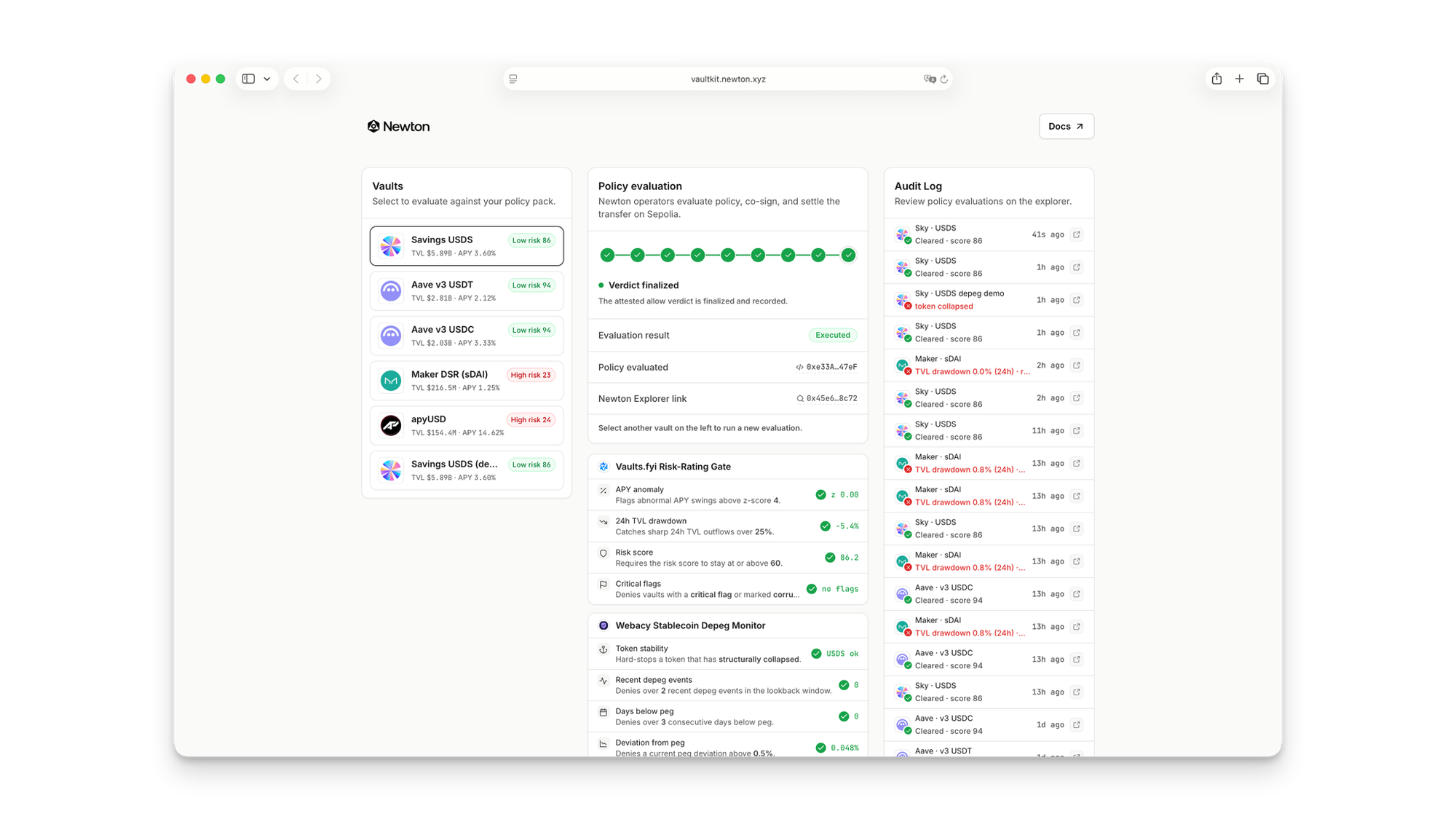
In practice, that means concrete policies. A vault can refuse to interact with a stablecoin that has a history of depegging or that crosses a depeg threshold. It can require a minimum level of liquidity before an allocator participates, and withdraw if that liquidity drops. It can screen out vaults whose tokens are concentrated among high-risk holders, or gate allocations on a curator's Webacy rating. These checks are queryable through the API and composable inside Newton's policy packs and the same protection can travel with an asset as it moves between vaults, RWA tokens, stablecoins, and bridges.This is exactly what VaultKit makes practical. Newton integrates Webacy's de-peg risk data directly into on-chain policy enforcement: before a vault manager can reallocate funds into a pegged asset, Newton operators evaluate the intent against live Webacy signals, blocking the action if the asset has collapsed, experienced repeated depeg events, or sustained days below peg. No code changes are needed on the vault itself; the policy gate simply sits in front of the manager's action.
The cost of finding out “after the fact”
Why does enforcement at the moment of truth matter so much? Consider a real failure pattern: an oracle hard-coded a stablecoin's price at $1, assuming it would always hold. When the coin depegged, the mispricing caused the vault's APY to spike, which in turn triggered curators' automated bots to pour more capital into a failing market. Real-time depeg detection stops that in its tracks. In another recent episode, a vault had to wind down over roughly $8.5 million in redemptions it couldn't meet not because of a headline stablecoin, but because a few investors lost trust in its liquidity and exited.
The lesson is that depegs don't happen in silos; bridge risk and shared holders mean contamination ripples outward. It echoes 2008 irresponsible products, contagion, “too big to fail,” and an investigation that only arrived after the damage was done. Onchain, those guardrails can instead be enforced up front and seen by everyone. Webacy is also helping bring standards to the space through DARC, a Digital Asset Ratings Council convening banks, asset managers, issuers, curators, and exchanges to answer an old question in a new world: who watches the watchers?

The seat belt for the autopilot of money
The throughline of everything Magic Labs has built from embedded wallets that solved onboarding to Newton enforcing rules at settlement is to make crypto indistinguishable from the finance people already know: deposit, earn yield, with risk managed and policies enforced quietly underneath. The near future pushes this further, as bots and eventually AI agents take over routine money movement, rebalancing, and keeping allocations within their limits. Newton was in fact designed for agent-managed vaults first “slightly early,” as its founder, Sean Li, puts it and proved out on human-run vaults in the meantime. When agents do manage capital at machine speed, the guardrails Newton and Webacy are building today become the seat belt for the autopilot of money: not a nice-to-have, but the reason it can be trusted at all.
See it on your own vault
Want to see Webacy-powered depeg enforcement gating real vault actions through VaultKit? Schedule your demo.
Watch the full episode: https://www.youtube.com/watch?v=ZEdPQTb7kNQ